How to Convert Oven Recipes to the Air Fryer
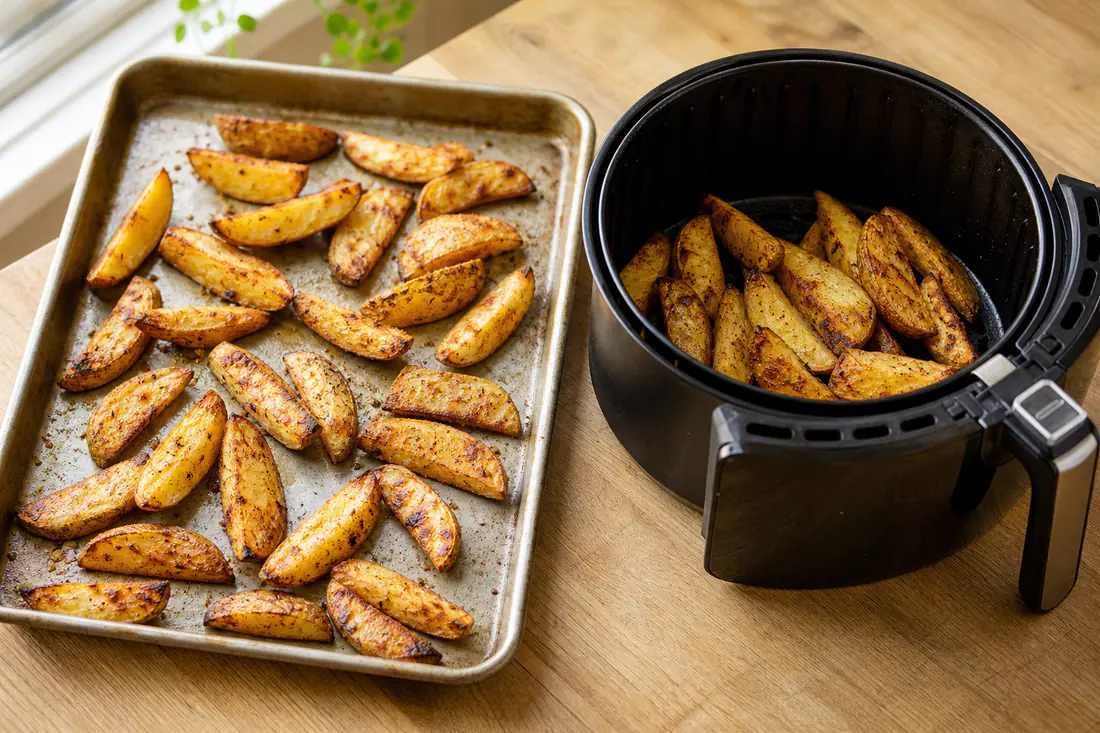
Most recipes are written for a conventional oven, but that does not mean you have to heat one up. An air fryer is a compact convection oven: the heating element sits close to the food and a fan moves the hot air quickly, so the surface browns sooner and the whole dish finishes faster. You only need to adjust two numbers, the temperature and the time.
This guide gives you the rule of thumb, a chart that compares typical oven settings with the settings in our recipes, and a list of dishes where the rule needs a second look.
The rule of thumb: 25 °F lower and 20–25% less time
When you convert an oven recipe to the air fryer, start here:
- Temperature: Lower it by about 25 °F. A recipe that calls for 400 °F in the oven becomes 375 °F in the air fryer.
- Time: Cut the time by 20–25%. A dish that needs 40 minutes in the oven needs roughly 30 to 32 minutes.
- Check early: Look at the food when about two-thirds of the time has passed. Air fryers differ in wattage and basket size, so a first check matters more than the math.
If the recipe was written for a convection (fan) oven, you have already lost some of the difference, so lower the temperature by 15–25 °F and cut the time by about 20%. When you are unsure, choose the lower temperature and add a few minutes. It is easy to cook food longer and impossible to uncook it.
For finished times by ingredient, see our air fryer cooking times chart.
Oven to air fryer chart with examples from our recipes
The chart below uses an example oven recipe for each dish, applies the rule, and shows what our tested recipe actually uses. The air fryer column is the one to trust. The rule gets you close, and the recipe reflects the real basket.
| Dish | Example oven recipe | Rule gives | Our recipe |
|---|---|---|---|
| Chicken breast, 8 oz | 400 °F, 25 min | 375 °F, 19–20 min | 375 °F, 18 min |
| Potato wedges, large | 425 °F, 30 min | 400 °F, 23–24 min | 400 °F, 22 min |
| Baked potatoes, 8 oz | 425 °F, 60 min | 400 °F, 45–48 min | 400 °F, 40 min |
| Salmon, 1 inch thick | 425 °F, 12 min | 400 °F, 9–10 min | 400 °F, 8–10 min |
| Meatballs, 1½ inches | 400 °F, 20 min | 375 °F, 15–16 min | 380 °F, 12 min |
| Pork chops, bone-in, ¾ inch | 400 °F, 20 min | 375 °F, 15–16 min | 400 °F, 12 min |
| Muffins | 350 °F, 20 min | 325 °F, 15–16 min | 320 °F, 15 min |
| Brownies, 6-inch pan | 350 °F, 28 min | 325 °F, 21–22 min | 320 °F, 25 min |
| Whole chicken, 4 lb | 375 °F, 90 min | 350 °F, 68–72 min | 360 °F, 1 hr 5 min |
Notice the pattern. For small, fast foods such as meatballs and pork chops, the real recipe is a little quicker than the rule, because the basket is small and the fan is close. For bakes and larger items, the recipe sits at or above the rule, because the center needs time to set.
How to convert a recipe step by step
- Lower the temperature by about 25 °F, or 15–25 °F for a convection oven recipe.
- Shorten the time by 20–25% and write down the new range.
- Preheat for 3 minutes. Oven recipes assume a hot start, and a short preheat keeps your timing honest. Preheat with the basket empty, never with loose paper or foil inside.
- Cook in a single layer. Hot air has to reach every side. Crowded food steams instead of browning, so cook in two batches if the basket is full.
- Shake or flip halfway. The heat comes mostly from above, so the underside browns less than it does on a sheet pan.
- Use a thermometer for meat. Time is a guide and temperature is the proof. The USDA safe temperature chart lists 165 °F for poultry and leftovers, 160 °F for ground meat, and 145 °F for whole cuts of beef, pork and fish (plus a 3-minute rest for beef, pork and lamb).
When the rule does not hold
The rule works best for pieces of meat, potatoes, vegetables and breaded foods. Here is where to be careful.
Large roasts
A big roast cannot cook faster just because the air moves faster, since the heat still has to travel to the center. Meanwhile the top sits near the element and darkens. Use a slightly lower temperature and rely on the thermometer. Our roast beef uses 375 °F for a 2 lb roast and drops to 350 °F for a 3 lb one, and the pork roast cooks at 350 °F.
Cakes, breads and other bakes
Batter needs to rise and set before it browns. The fan and the nearby element brown the top early, so lower the temperature by 25–30 °F, use a smaller pan than the oven recipe calls for, and tent the top with foil if it darkens early. Our banana bread bakes at 310 °F with a foil tent, and the bread recipe uses a pan and a loose foil cover too.
Dishes with lots of liquid
Casseroles, soups and saucy bakes gain little from the dry, circulating air. The liquid still has to heat through, and the top may brown long before the middle is hot. Cover the dish for the first part and expect a time closer to the oven's. The lasagna recipe, for example, takes 35–40 minutes for a small dish at 350 °F.
Frozen food
Frozen foods usually need a lower temperature and more time than fresh, so the middle thaws before the outside darkens. Fresh chicken breast takes 18 minutes at 375 °F, while frozen breasts take 22–25 minutes at 360 °F. More examples are in our guide to frozen foods in the air fryer.
Frequently asked questions
How much do I lower the temperature when converting from oven to air fryer?
Lower it by about 25 °F. If the recipe is already written for a convection oven, lower it by 15–25 °F. For delicate bakes, go 25–30 °F lower.
How do I convert oven time to air fryer time?
Cut the time by 20–25%. A 40-minute oven recipe becomes about 30 to 32 minutes. Check the food when two-thirds of the time has passed, since every machine runs a little differently.
Should I preheat the air fryer when following an oven recipe?
A 3-minute preheat gives the most predictable result, because oven recipes assume a hot start. Preheat with the basket empty and add the food afterward. Never leave loose parchment or foil in the basket while it heats.
Can I use the oven time on a frozen food package?
Use it as a starting point with the same rule. Lower the temperature about 25 °F, cut the time 20–25%, and check early. Many packaged foods are already cooked and only need to heat through and crisp.