
Do Air Fryers Use a Lot of Electricity? What a Batch Really Costs
Air fryers are rated at well over a thousand watts, which makes many people wonder if they will show up on the electric bill. The short answer is that a single batch costs a few cents to about a dime, and the machine is usually cheaper than heating a full-size oven for the same job.
This guide shows how to work out the cost yourself, gives worked examples from our own recipes, and explains when the oven or the microwave is the better choice.
Do air fryers use a lot of electricity?
Not compared with most other kitchen appliances you run for a meal. Most basket air fryers are rated at roughly 1,400 to 1,800 watts, and the label on the back or bottom of your model shows the exact number. That sounds like a lot, but the machine only draws that power while the heating element is on. Once it reaches the set temperature, the element cycles on and off, so real use is usually below the rating.
What keeps the bill low is time. A basket is small, heats in about 3 minutes and cooks most foods in 10 to 25 minutes. A short run at high wattage still adds up to little energy.
How to calculate the cost to run your air fryer
You need two numbers: the wattage on the label and your electricity price per kilowatt-hour (kWh), which is printed on your utility bill.
- Divide the watts by 1,000 to get kilowatts.
- Multiply by the hours of cooking to get kWh.
- Multiply the kWh by your price per kWh.
The U.S. Energy Information Administration's Short-Term Energy Outlook puts the average U.S. residential price at 17.3 cents per kWh in 2025 and forecasts 18.2 cents per kWh in 2026. Your own rate may be higher or lower, so use the figure from your bill when you have it.
Example: a 1,500 W air fryer running for 20 minutes uses 0.5 kWh. At 18.2 cents per kWh that is about 9 cents, as a rough estimate.
Air fryer cost to run per hour
Few recipes take a full hour, but an hourly figure makes it easy to compare models. These are rough estimates at 18.2 cents per kWh, assuming the element runs the whole time, which overstates the cost.
| Rated power | Energy per hour | Cost per hour (rough estimate) |
|---|---|---|
| 1,400 W | 1.4 kWh | about 25 cents |
| 1,500 W | 1.5 kWh | about 27 cents |
| 1,800 W | 1.8 kWh | about 33 cents |
So the cost to run a 1,800 watt air fryer for an hour is about a third of a dollar at that rate. Because the element cycles, the real number is usually lower.
What a batch costs: worked examples
Here are the same rough estimates for dishes from our recipes. They assume a 1,500 W air fryer, 18.2 cents per kWh, the recipe's cooking time (a 3-minute preheat adds about 1–2 cents) and the element on the whole time.
| Dish | Setting | Time with preheat | Energy | Rough cost |
|---|---|---|---|---|
| Reheated pizza slices | 350 °F | 7 min | 0.18 kWh | about 3 cents |
| Hard-boiled eggs | 300 °F | 18 min | 0.45 kWh | about 8 cents |
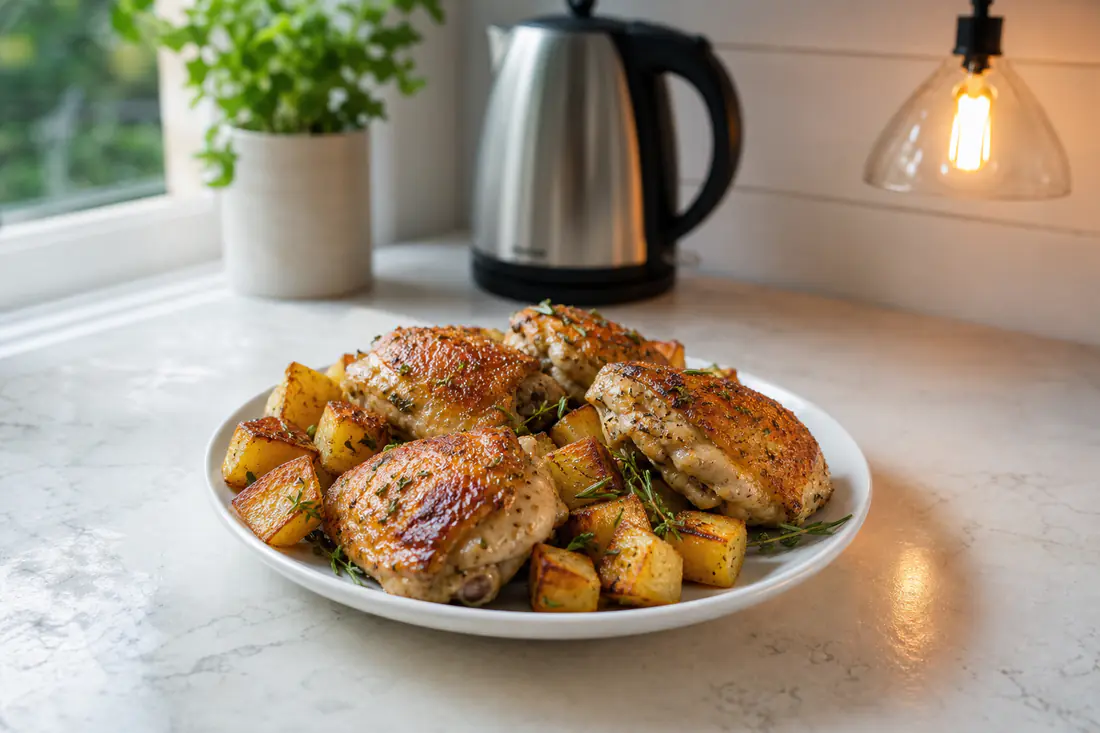
| Roasted potatoes | 400 °F | 23 min | 0.58 kWh | about 10 cents |
| Bone-in chicken thighs | 400 °F | 25 min | 0.63 kWh | about 11 cents |
| Chicken wings | 400 °F | 27 min | 0.68 kWh | about 12 cents |
| Medium baked potatoes | 400 °F | 43 min | 1.08 kWh | about 20 cents |
Even a long cook like baked potatoes stays around a fifth of a dollar. If your rate is double the national average, double the cost column.
Air fryer vs oven
A full-size electric oven heats a much larger box. It also usually needs a 10 to 15 minute preheat before the food goes in, and that time costs energy before any cooking starts. The rating plate inside the oven door or frame lists its wattage, so you can run the same formula.
An air fryer wins on small and medium jobs for three reasons:
- Smaller space: it heats a basket, not a whole cavity.
- Little or no preheat: about 3 minutes, and some foods go in cold.
- Shorter cooking: moving hot air browns the surface sooner. See how to convert oven recipes to the air fryer for the usual adjustments.
Air fryer vs microwave
For reheating a small portion, the microwave usually costs less, because it warms the food directly and often needs only a minute or two. The trade-off is texture. Breaded foods, pizza and fries turn soft in the microwave, so many people spend the extra few cents on the air fryer for those. Rice, soup and sauces are better in the microwave or on the stovetop. For crisp leftovers, see reheat fries in the air fryer.
When the oven is still the better choice
Use the oven when you are cooking a lot at once. A basket holds one batch, so feeding a crowd can mean three or four rounds, and the running cost and your time add up. A full sheet pan of vegetables, two trays of cookies or a holiday meal are oven jobs. On busy days the two appliances work well together, as in our Thanksgiving in the air fryer guide. For a full list of settings, see the air fryer cooking times chart.
Ways to lower the cost further
- Cook full batches when the basket allows it, but do not crowd it.
- Skip the preheat for foods that tolerate it, as noted in each recipe.
- Keep it clean. Grease buildup affects airflow and smoke, and our guide to cleaning an air fryer covers it.
Frequently asked questions
Do air fryers use a lot of electricity compared to a microwave?
For reheating a small portion, a microwave usually costs less because it runs for a shorter time. For crisp food, the air fryer is the better tool, and the cost difference is a few cents.
How much does an air fryer cost to run for an hour?
Divide the rated watts by 1,000 and multiply by your price per kWh. At 18.2 cents per kWh, a 1,500 W model comes to about 27 cents as a rough estimate, and less in practice because the element cycles.
How much does a 1,800 watt air fryer cost to run?
About 33 cents for a full hour at 18.2 cents per kWh, as a rough estimate. Most meals take 10 to 25 minutes, so a batch costs a few cents to about a dime.
Is an air fryer cheaper than an oven?
Usually, for small and medium batches, because it heats less space and needs a shorter preheat. For large batches the oven can be the better choice.
Where do I find my electricity rate?
Look for the price per kWh on your utility bill or online account. The national average is only a guide.